The content foundation that prepared enterprise implementation communications for automation
The business had been trying to get these emails audited, culled and rewritten for seven years. Every attempt paused before completion.
The implementation communications were the emails project managers sent to keep enterprise customers informed between contract signing and billing activation. Over time, templates were added, copied and edited by whoever needed them. Approximately 160 emails later, the library had inconsistent voice, inconsistent terminology and no governance or oversight.
I led the content strategy, audit and rewrite as principal content designer. The result was a 50% reduction across the full implementation email library, a 75% reduction in the introduction phase alone, a taxonomy now used beyond implementation, and a modular content system used throughout the business.
My role
I led this project as principal content designer. A member of my content design team joined after the project was in flight. I owned the audit and the strategy, we rewrote and led review sessions together. We had a group of implementation project manager subject matter experts who gave technical advice and program managers who kept us moving. Partners on the strategy side included directors, VPs and an EVP.
Auditing came first
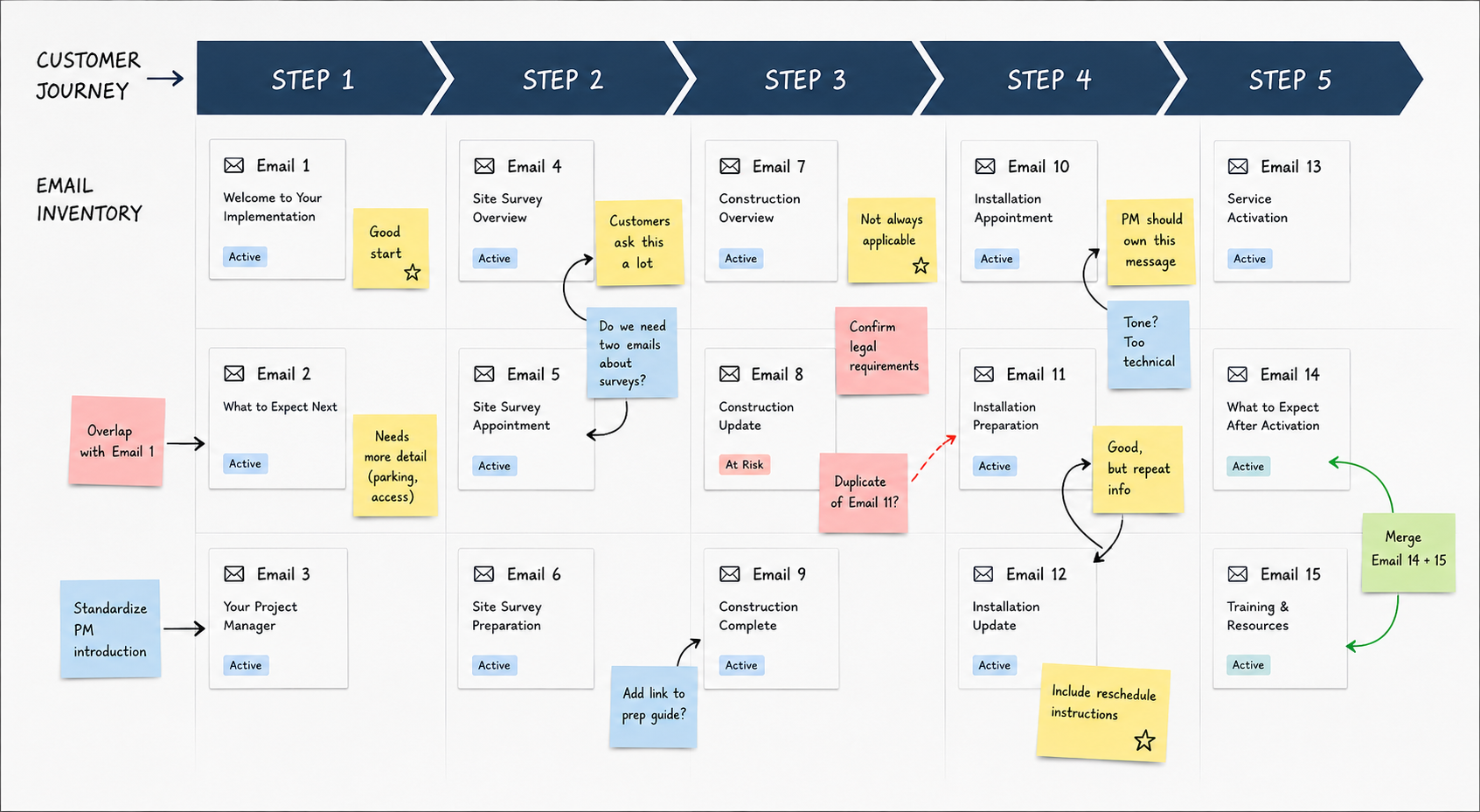
Before anything was rewritten, everything was inventoried. We documented every communication in Lucid, mapping each email across five journey phases from introduction to billing activation. Sticky notes from our SME sessions covered the board.
We ran weekly working sessions with the project managers who knew these emails better than anyone. They brought business and process knowledge we couldn't know; we brought content and experience standards. The process was cyclical: we reviewed independently, workshopped with the SMEs, revised and came back for approval. We could not have made confident reduction decisions without them.
Reduction as strategy
The introduction phase had accumulated the most bloat. We cut it by 75%, replacing long, complicated, multi-voice content with one consistent human voice: their project manager. This aligned directly to work happening in the PM organization, where a single project manager owns the customer relationship from start to finish.
Across the full library, the total reduction was 50%. Fewer communications. Clearer purpose. Every email that remained had a reason to exist.
One voice, one person
Before this project, emails came from a project manager but frequently said things like "this team will be reaching out" or "you will hear from this department." The customer was being handed off on paper, but not in a way that felt connected, and CES scores proved it.
We rewrote everything to make sure all communications came from one person. The PM knew the customer, knew the timeline and guided them through the process. Internal hand-offs in copy were removed. Internal jargon went with them, something the SMEs helped us identify. "Do customers understand this? Do you have to define this to customers?" were standard workshopping questions. The PMs were quick to tell us when things were confusing to customers.
In the end, the emails read like they were actually written by the person sending them. We focused on the little details, as well as the big ones. I made sure the font and size matched to Outlook so when PMs copied, pasted and added fields into the template, everything matched. When the customer replied and the PM responded, there was no font transition to signal a different system had been involved.
Taxonomy as infrastructure
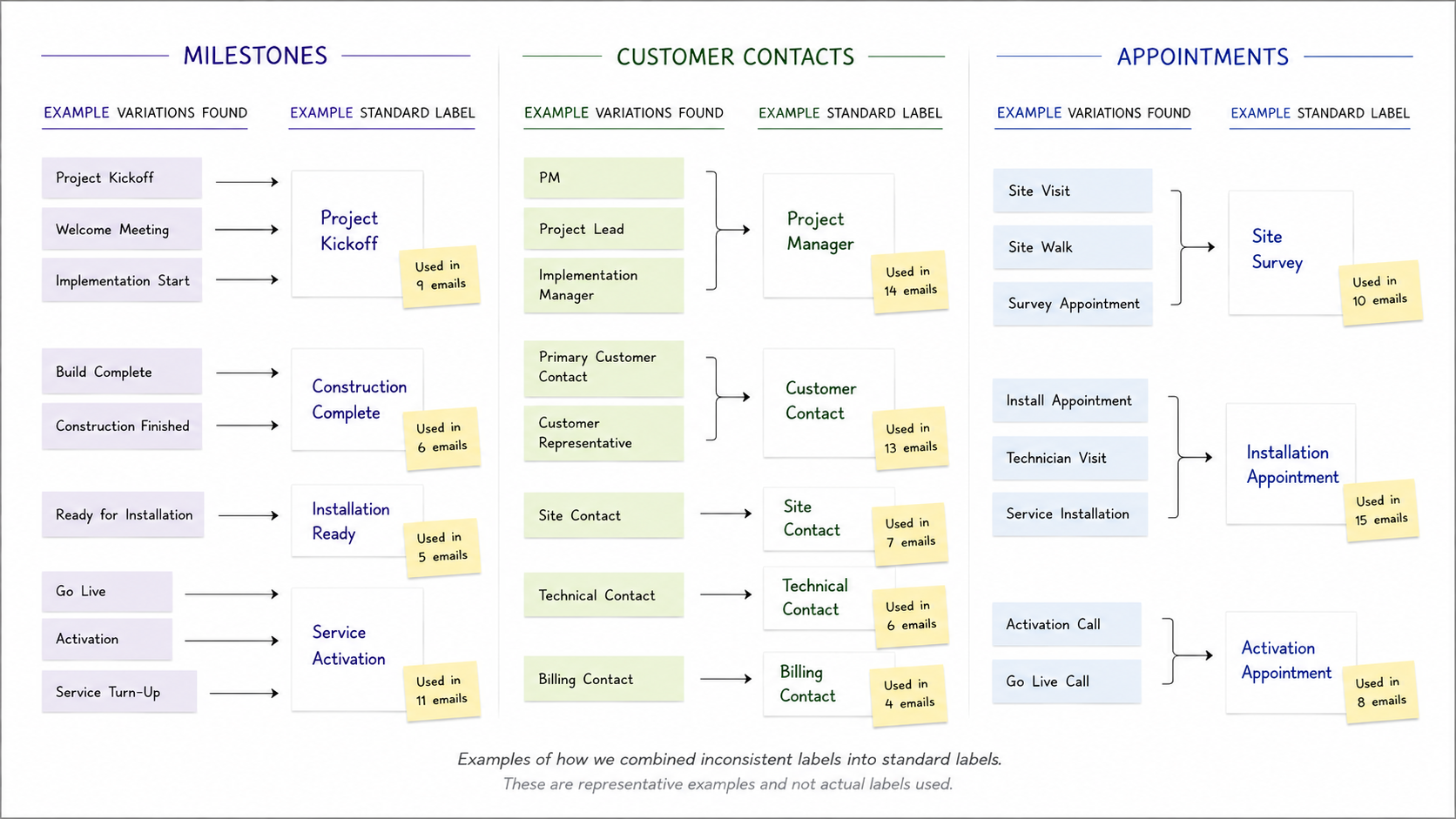
One of the most significant contributions of this project was establishing content label taxonomy. Before this work, dates, appointments, customer contact roles and milestones had inconsistent naming conventions across every email.
I met with directors and VPs to nail down finals. Terminology was standardized. Dates and data points followed the style guide. Customer contact roles were defined and named consistently everywhere.
This taxonomy did not stay inside implementation. It became a baseline for how the company spoke to customers throughout the entire journey, setting a standard that outlived the project.
Modular content blocks
This was not part of the original plan, but it became clear to me very quickly.
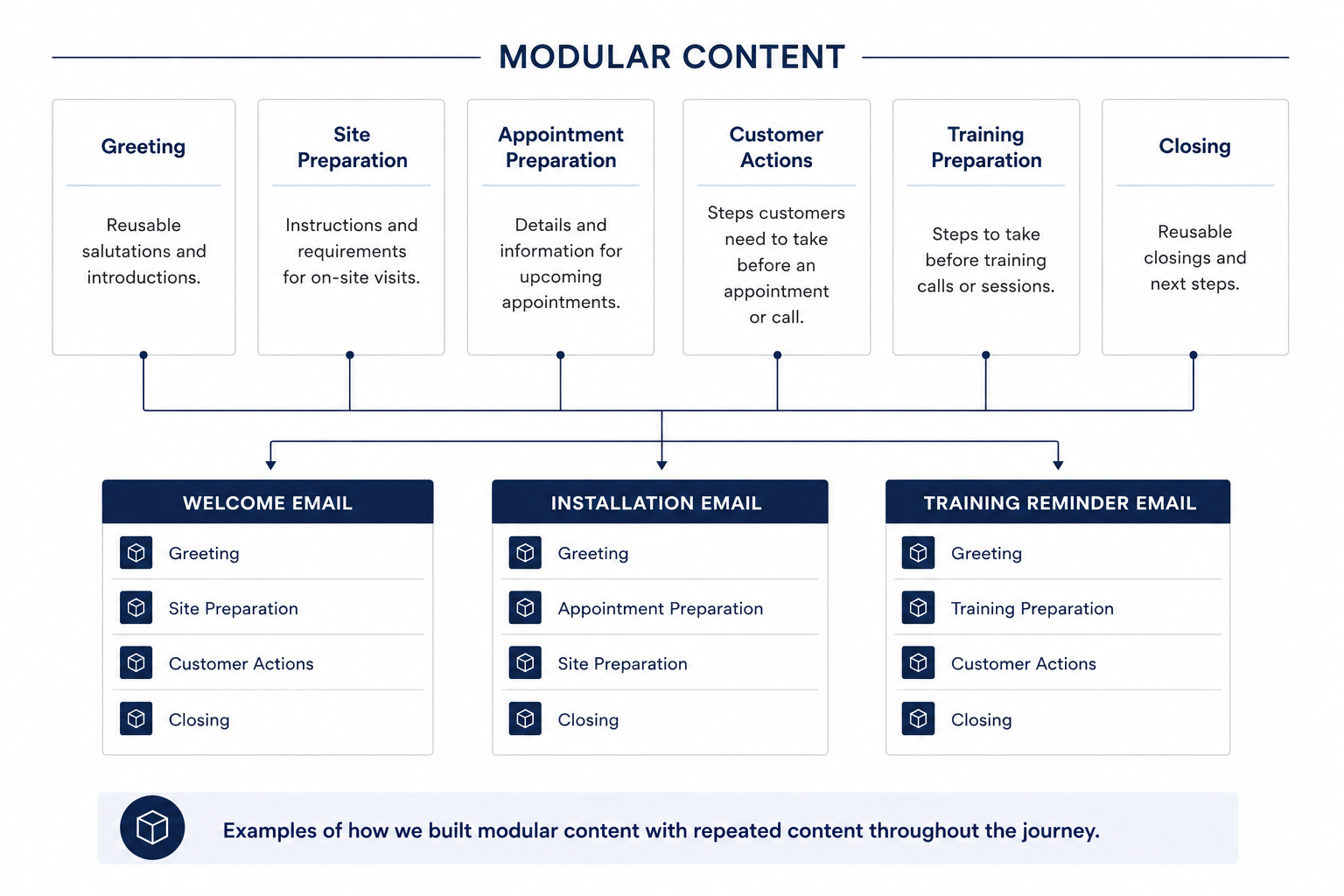
Working through each email, I noticed the same information appearing across multiple emails, written slightly differently every time. Site preparation details, appointment information, salutations and closings, data blocks displayed inconsistently from email to email.
I explained the solution to executive stakeholders as Lego bricks. We built many of them, each designed to drop into any email where that content belonged. Every time that information appeared across the journey, it was identical, word for word.
How AI fit in
About 75% of this project was manual, prior to our company's AI integration. The audit, strategy, SME collaboration, decision-making and most of the rewriting were done without it.
I used Kiro, our team's AI tool for design work, to manage the content library at scale. It worked perfectly for this task. I uploaded every email as a document, and Kiro gave me a way to move across all of them, finding where content blocks appeared, confirming they were identical and flagging inconsistencies I could then resolve. When the same information showed up in more than one place, it helped me hold it consistent everywhere.
A human made every strategic decision and AI kept it consistent at scale.
Built for automation
Automation was already in flight, but in early days. Digital UI would soon be the delivery method for many of these emails, tied to order tracking and status work. Because the content was modular and governed before that work began, the working team would inherit a content system instead of a content problem to deal with then.
The modular blocks were designed to work directly into that UI in a way that a rewrite alone would not have supported.
Outcomes
Every customer moving through implementation now has one consistent, human voice guiding them through. The emails are shorter, simpler and use plain language throughout. Action steps are clear. The PM voice is genuine and jargon is limited.
The communications library was delivered ready for use as is and ready for automation when that work arrived.
50% reduction across the full implementation library. 75% reduction in the introduction phase. Taxonomy now used beyond implementation, across the full customer journey. Modular content blocks ready for automation.
Reflection
Sitting between a manual content library and an automated future was an amazing education. Building something that had to work right now and also had to hand off cleanly to automation required thinking at both levels at the same time.
Understanding the full ecosystem before editing a single email was the reason this project evolved from a rewrite to a future automation-ready effort. A general edit would have left a messy rewrite down the road.
SME collaboration with the project managers was critical because they carried knowledge we didn’t have. Their process expertise and our content expertise was a superpower combo.