Creating a style guide for technical enterprise users
I joined the enterprise team as the sole content designer and was told to follow the company-wide product style guide. It was built for residential and small business products. Many of our enterprise customer users are IT professionals managing complex technical environments. As I engaged with the enterprise client portal, I realized the style guide was inadequate for technically savvy IT professionals. I also learned the enterprise marketing team had its own distinct style guide, creating significant misalignment in enterprise content creation.
My role
I led the creation of the enterprise style guide end to end, as a solo content designer. I owned the audit, the workshop facilitation, the research, the stakeholder alignment and the documentation. It is now part of the design guidelines, used by product, marketing and client engagement teams. It continues to grow as new decisions are made..
Before I Dig In
For the record, it’s hard to jump right into where I started, as a lot of time was spent pondering how to approach this massive, high-visibility, major-impacting project as a busy solo content designer. I have created style guides and editorial guidelines in the past, but this was different - there were already style guides being used, and it was my job to find discrepancies so we could align and have proper guidance for all future designs. An incredible percentage of this project was in the weeds, researching, gathering and documenting until I had enough knowledge (and courage) to put pen to paper.
Voice analysis
I started analyzing voice and tone guidelines from the original product style guide and enterprise marketing style guide. Seeing the residential and small business voice and tone guidelines next to enterprise marketing voice and tone was very eye-opening. It was clear this was the part that needed solidifying before I could move forward.
Workshop
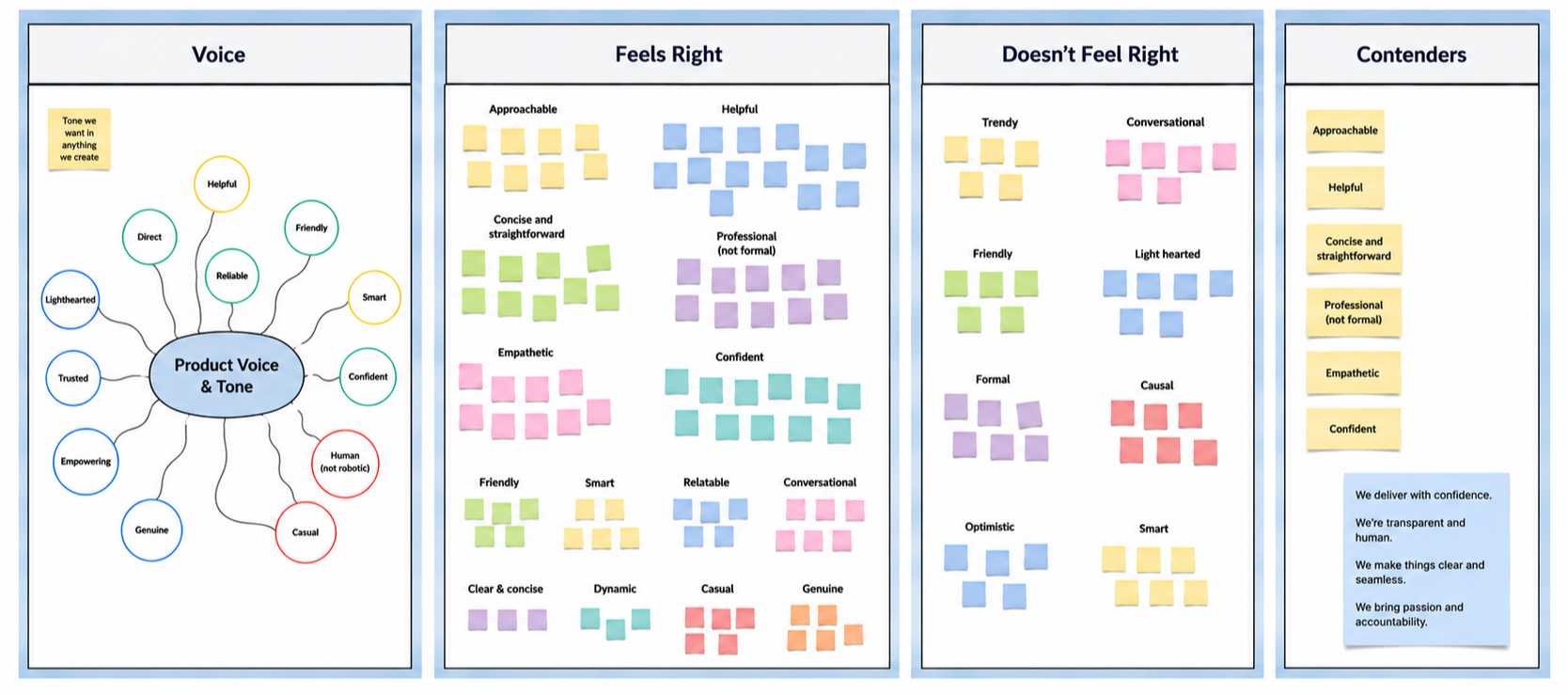
I conducted an interactive workshop in Lucid for the design team, where we delved into the voice and tone guidelines from the company’s multiple style guides. I pulled all of the voice attributes together.
We reminded ourselves about the average enterprise user, using personas created by our research team as reference points. Recognizing the diverse nature of our users, ranging from billing professionals and IT experts to individuals with minimal IT experience, we identified that certain residential and small business voice qualities didn’t feel right for enterprise users.
Documentation
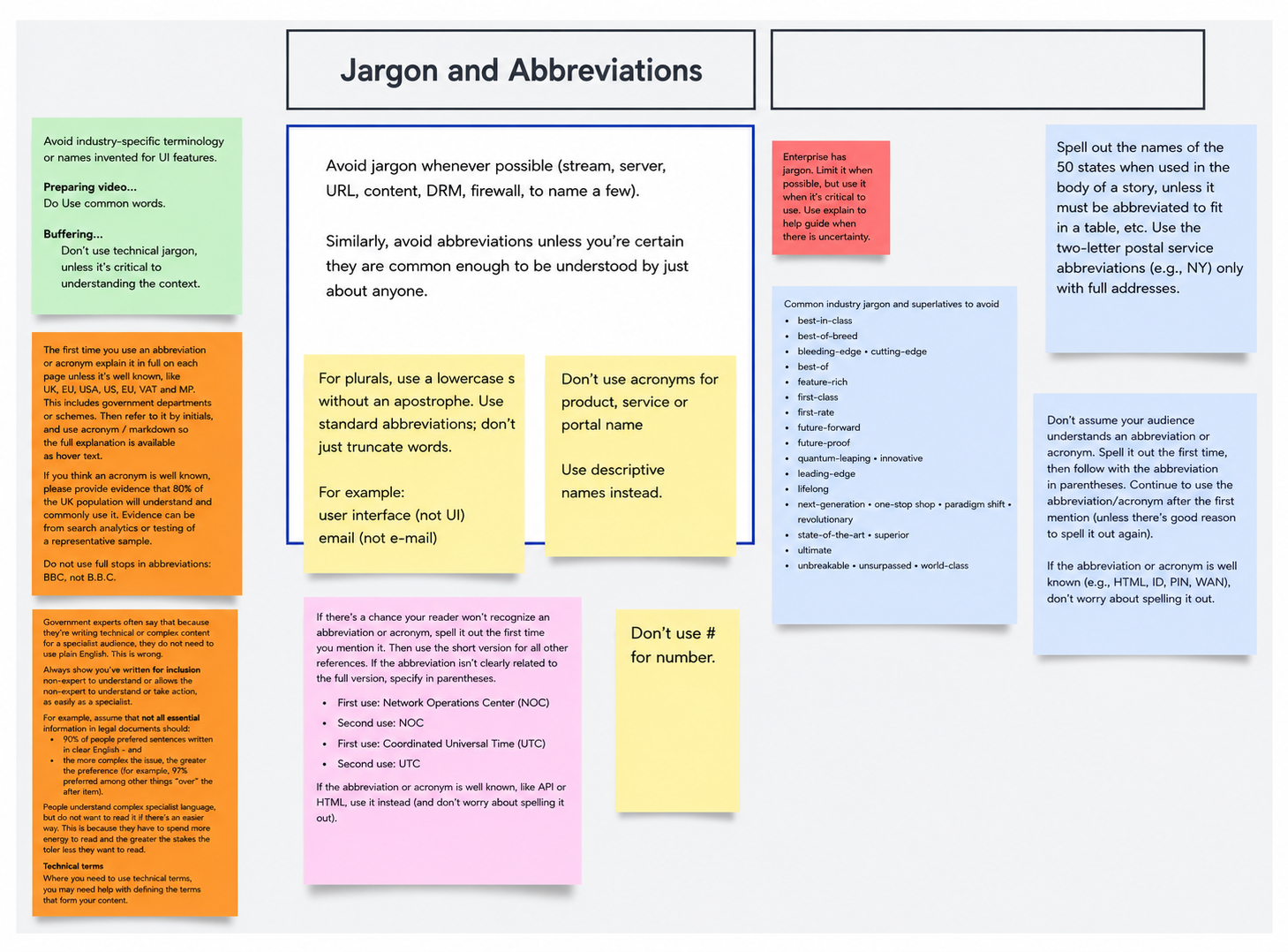
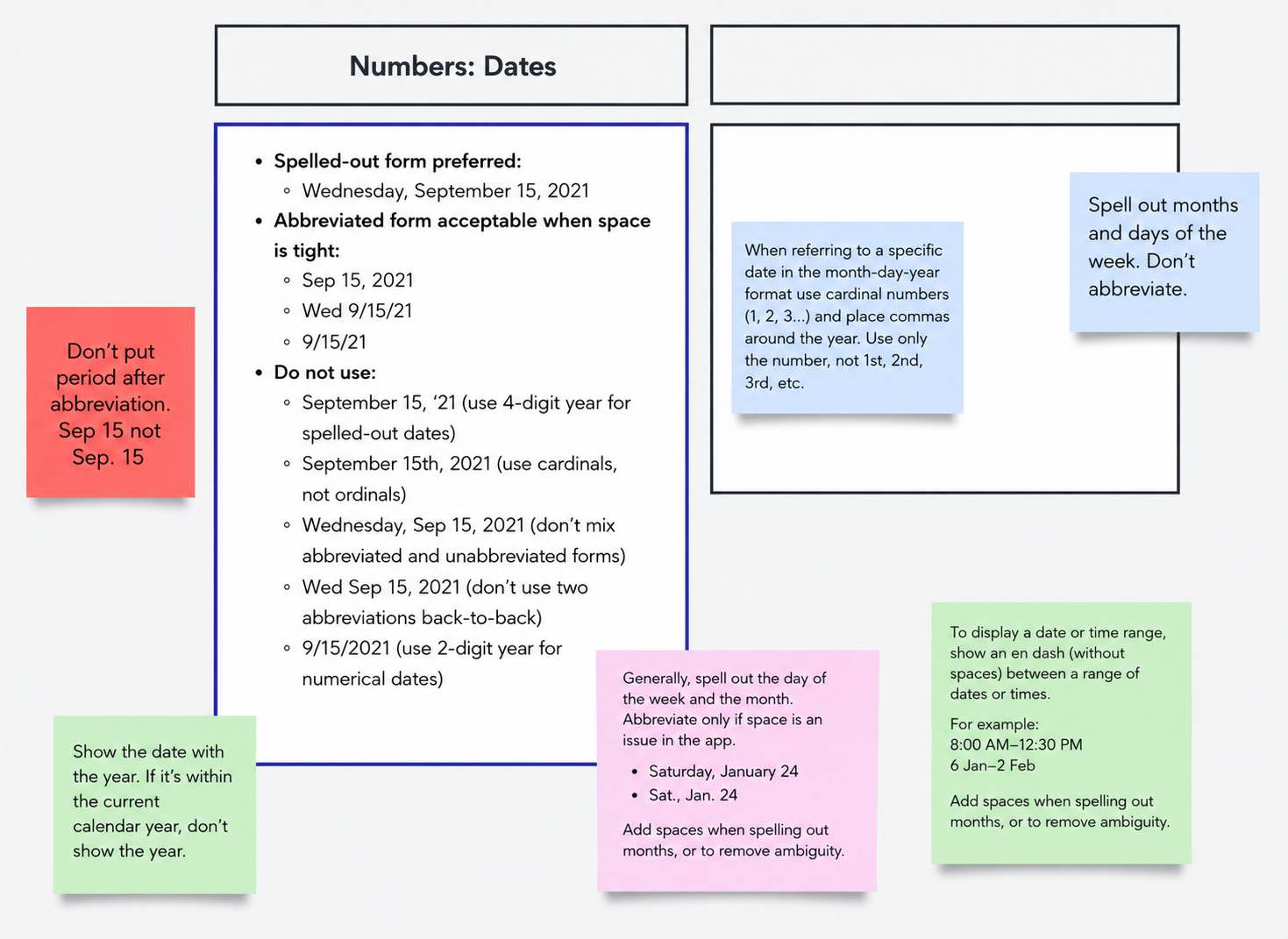
I documented all entries from the residential and small business style guide on sticky notes on a Lucid board. Unlike a traditional alphabetical style guide, it focuses more on the approach to designs, covering aspects like formatting headers, CTAs in roadblock modals and the acceptance of legal terms. I then broke down the information into granular entries, aiming for a more layout more similar to an AP style guide in the end. I did the same with the enterprise marketing style guide.
The high-level side-by-side view revealed areas where the guides aligned and many areas where they did not, for example, capitalization. At the time, marketing used sentence case in all enterprise efforts, including .com website. Residential / SMB followed title case for all efforts, including their .com website. That means our enterprise clients see sentence case on .com and title case in our client portal. Urgent? No, but for a content designer, most definitely.
Research
I researched public-facing corporate style guides, drawing inspiration from companies like Intuit, Mailchimp, Google, Yahoo and others. This helped me identify areas where we could take a design-centric approach rather than a system or developer-oriented one. This deep dive into other style guides was such a reminder of the vastness of content design. I found it refreshing to see how others documented their guidance, and examples they gave correct and incorrect versions for visual guidance. This research and documentation stage provided the foundation I needed to build the new style guide.
Setting Standards
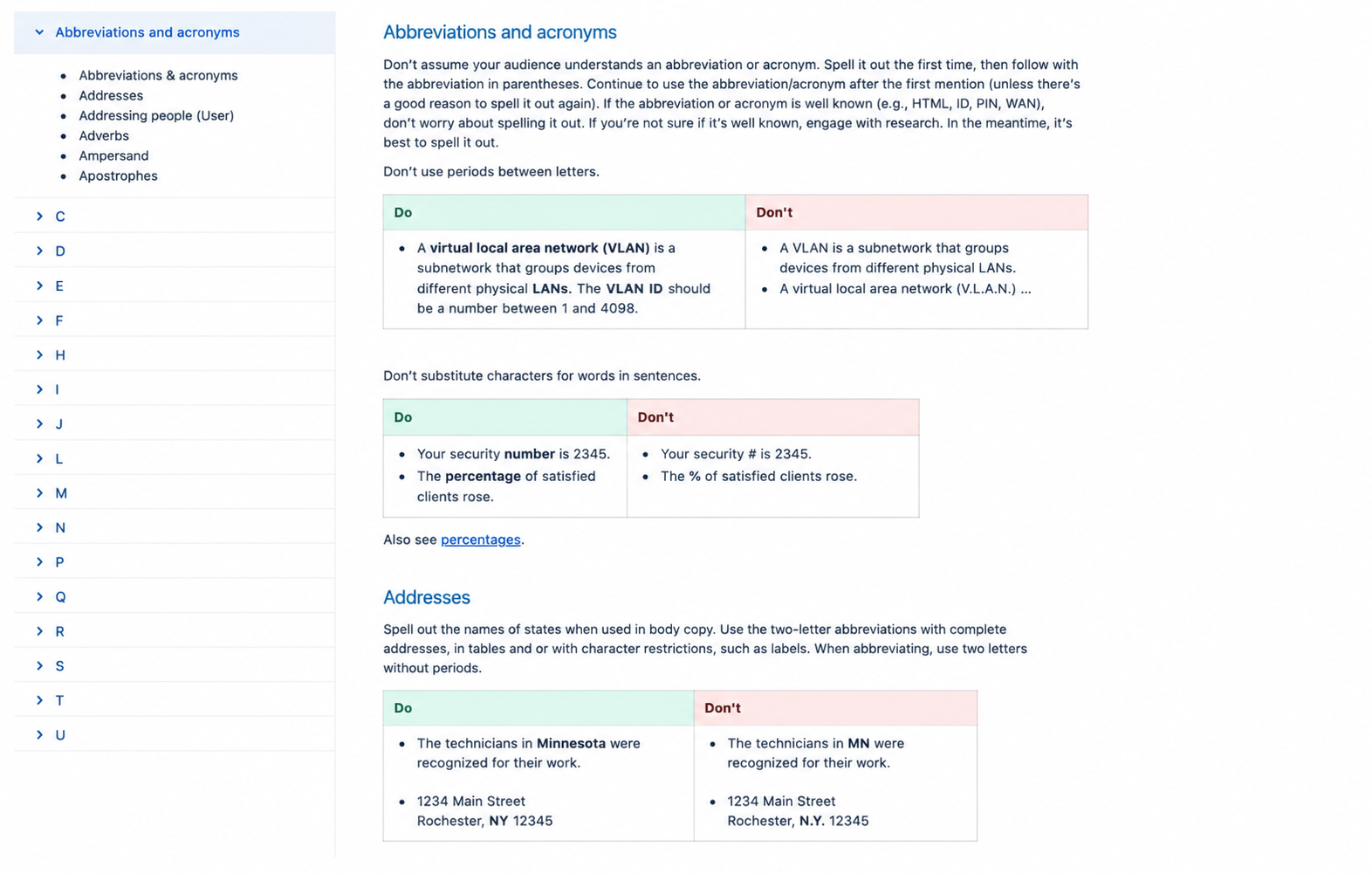
After selecting how we’d approach most style guide entries, I created an alphabetical list of guidelines on our internal-facing website. The benefit of this is that each entry would have its own URL to share among the team, or in Figma if there was a specific area that stakeholder feedback didn’t align.
Cross-functional collaboration
Leadership: Our VP pointed out ways this could be infused throughout the organization and gave direction on which stakeholders would need to give input before calling it complete.
Product: Product managers and product owners engaged from different angles. PMs focused on design alignment. POs focused on what it meant for the dev team. I planned the dev team meeting for after all other stakeholder feedback was incorporated, so their handoff was clean.
Client engagement: This team was looser in their own documentation but open to connecting with the new guide. One team member reviewed and her feedback led to a few iterated entries.
Marketing: The marketing manager was first curious why we couldn’t just use the enterprise marketing style guidelines. We had a good conversation about UX writing vs. marketing copywriting. I explained that the marketing guide was incorporated into the new guide, but we needed more. We had tables and cards and actionable flows to consider. It was a great collaborative conversation. He engaged positively and gave feedback, and our connection was a big win. We didn’t align everywhere, but where we didn’t was very minor - for example, when to use punctuation at the end of list items.
Outcome
A style guide that is aligned with our actual users, not only residential and small business users. While its main audience is product design, it’s a significant resource for all enterprise content-creating teams, including marketing and client engagement. It has become part of our design process in a much more concrete way. It is a living document, and new guidelines are documented as they arise. There is a greater connection between product and design teams in terms of content efforts, which was apparent during design bug documentation efforts.
Reflection
Creating a style guide is a massive project that should be done as a team. Diversity in thought, experience and approach can take things deeper over one person’s thoughts, experience and approach. If you’re considering creating a style guide for your organization, create a content design team to tackle.
It’s important to analyze style guides when they don’t feel totally aligned with the user. If you’re feeling friction, they probably are too.
Product + marketing relationships are important for content, especially when creating the best user experience. Build bridges and connect often.